
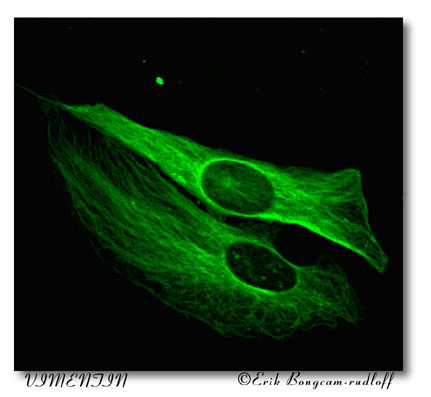
What are astrocytes?
Astrocytes are star-shaped glial cells in the central nervous system. They help keep the environment around neurons stable, recycle neurotransmitters, support the blood–brain barrier, and contribute to how synapses are formed and maintained. In modern neuroscience they are no longer viewed as passive support cells, but as active regulators of brain physiology.
What is GFAP?
GFAP stands for Glial Fibrillary Acidic Protein. It is a major intermediate filament protein of many astrocytes and forms part of the internal scaffold that gives these cells shape and mechanical resilience. Because GFAP is strongly associated with astrocytes, it became one of the classic molecular markers used to identify them in tissue sections and cell cultures.
A personal research milestone: sequencing the human GFAP gene
In 1991, Erik Bongcam-Rudloff and colleagues published a Cancer Research paper describing the human GFAP complementary DNA sequence. This was an important step in the molecular characterization of a classic astrocyte marker and helped support later work on astrocyte biology, gene regulation, tumor biology, and disease-related GFAP variation.
Reference: Bongcam-Rudloff E, Nistér M, Betsholtz C, Wang JL, Stenman G, Huebner K, et al. Human glial fibrillary acidic protein: complementary DNA cloning, chromosome localization, and induction by forskolin. Cancer Res. 1991;51(5):1553–1560.
Milestones in astrocyte and GFAP research
Astrocytes and memory: what is the idea?
For many years memory research focused almost entirely on neurons. That focus was justified—neurons clearly store and transmit information through synaptic plasticity. But newer work shows that astrocytes are closely involved in the same circuits and may help regulate how memories are formed, stabilized, or retrieved.
Why scientists are interested
- Astrocytes wrap around synapses with fine processes and can shape the local chemical environment.
- They take up glutamate and other signaling molecules, influencing how strongly neurons communicate.
- They show calcium activity that can coordinate with neuronal activity.
- They provide metabolic support, including lactate, which has been linked to long-term memory formation.
- Recent transcriptomic studies suggest astrocytes can show lasting molecular changes after learning.
A careful, evidence-based speculative view
Based on recent research, the most reasonable working hypothesis is not that astrocytes “store memories” by themselves in the same way neurons do. Rather, astrocytes may help shape the conditions under which memories become stable. They may tune synaptic strength, support energy-demanding plasticity, and contribute to the long-term maintenance of circuit states. In some situations, astrocyte ensembles may even participate in preserving the persistence of emotionally important memories.
Why GFAP still matters
GFAP remains important because it links cell biology, neuropathology, and molecular neuroscience. It is used routinely to identify astrocytes, to assess reactive astrogliosis, and to study disorders such as Alexander disease. At the same time, researchers now recognize that GFAP is only part of the astrocyte story: many astrocyte functions depend on fine peripheral processes that can be only weakly labeled by classic GFAP staining. In other words, GFAP is a powerful marker, but astrocyte biology is even richer than GFAP alone reveals.
Selected references
- Bongcam-Rudloff E, Nistér M, Betsholtz C, Wang JL, Stenman G, Huebner K, et al. Human glial fibrillary acidic protein: complementary DNA cloning, chromosome localization, and induction by forskolin. Cancer Res. 1991;51(5):1553–1560.
- Messing A. GFAP at 50. ASN Neuro. 2020;12.
- Verkhratsky A, Nedergaard M. Physiology of astroglia. Physiol Rev. 2018;98(1):239–389.
- Liddelow SA, Barres BA. Reactive astrocytes: production, function, and therapeutic potential. Immunity. 2017;46(6):957–967.
- Sun W, et al. Spatial transcriptomics reveal neuron–astrocyte synergy in long-term memory. Nature. 2024.
- Dang R, et al. Astrocytic neuroligin 3 regulates social memory and astrocyte calcium signals. Nat Commun. 2024.
- Dewa K, et al. The astrocytic ensemble acts as a multiday trace to stabilize memory. Nature. 2025.